

Overview
The purpose of this blog post series is to provide conceptual frameworks and practical tools that improve your performance as a leader. Emerging best practices in AEC operations, driven by lean, operations science and progressive design-build, require us to rethink leadership. No matter where you are in your organization, whether you are a construction crew or design/engineering team member, a foreman or project manager, or a corporate executive, this High-Performance Leadership tool kit will help you.
Objective
In this tenth and final post, we present more of what you need to know to become a High-Performance Leader. In this post we finish the discussion of collaborative problem solving started in HPL Post #9. This post presents a facilitator’s roadmap for a series of small agreements that lead to a solid final agreement.
High Performance Leadership: Facilitation of Collaborative Problem Solving
Welcome back to this High-Performance Leadership Blog Series. If you have not read Posts 1-9 yet, please consider doing so. They will set the stage for this last discussion.
In post #9 we asserted that problem solving is all about changing an unsatisfactory current situation into a better situation.
Remember, if you don’t agree on the problem, you probably won’t agree on the solution. Big agreements on the problem and the solution can fall apart when we fail to build a foundation of smaller agreements, including:
- Is this a problem situation that needs to be addressed now?
- Do we sufficiently understand the situation, its important elements and causes?
- Do we have a clear, compelling definition of the issue(s) to be addressed?
- Have we envisioned and agreed on what success should look like?
- Has that vision of success been turned into clear Conditions of Satisfaction (COS) and success criteria by which we can measure the results of our new actions?
- Have we identified all the solution/improvement options we should consider?
- Have we evaluated those options to understand the relative advantages/value of each?
- Have we agreed on solutions/improvements to recommend for implementation?
- Have we committed ourselves to an implementation plan?
These agreements become the building blocks for a solid commitment to action.
Leaders must plan and facilitate many discussions and activities that build team commitment. Each major discussion topic – problems and causes, our vision of success, possible solutions, and implementation commitments, requires focused, productive collaboration. The High-Performance Leader must be clear which topic areas will be addressed, in which order. They must plan to generate the information or action needed at each step and focus on the agreements needed at each problem-solving meeting.
Each area of focus — Problem, Vision, Solution – goes through the 3 Phases of a Conversation.
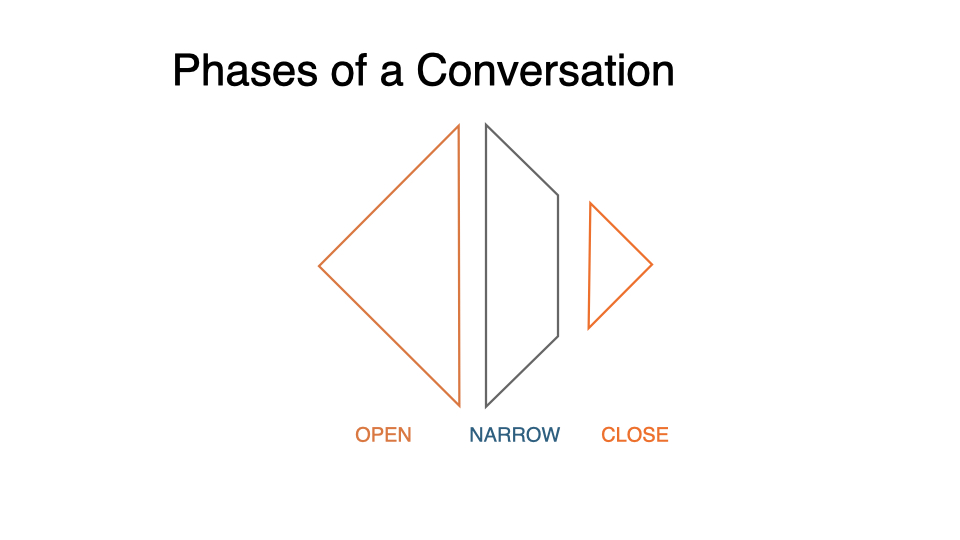
Interaction Associates, a developer of advanced facilitation and collaboration leadership skills training, developed the two models presented above and below. The diamond-shaped model above depicts the discussion phases of each major problem-solving topic: Problem, Vision, Solution. For example, to get to an agreement on what the problem is, we need to generate information about the situation. The Leader/Facilitator uses processes and tools that create an open, curious, creative space where ideas and experiences are shared and captured. The process should generate useful information including both personal perceptions/experiences, and hard data. Next, we need to understand and organize that information to make sense of it and identify what is important. The narrowing process requires analytical thinking, more like Sherlock Holmes. Finally, we need to close the discussion with agreements on a problem definition and summary. This takes Win/Win thinking and decision-making skills, discussed earlier in this series.
The facilitative leader must be clear which topic we are working on, which phase of the discussion we are in, and which facilitation tools will be deployed to keep the discussion on topic, and productive. Imagine planning a cross-country trip. The High-Performance Leader must zoom out to the national map to choose a route and measure progress toward the ultimate destination, then zoom in to the state map to assess upcoming terrain, and then zoom in further to plan the next couple of hours of driving.
The problem-solving roadmap below helps us plan a journey through definition and analysis of the current situation and it’s causes. It helps us envision an improved situation and agree on the solution(s) that must be implemented. It gets from where we are to where we want to be. Most importantly, through these steps, we build commitment to take corrective actions.
Here is the big “roadmap” developed by Interaction Associates, to help us create an initial route, track our progress using a series of agreements as milestone markers and safely navigate the upcoming terrain.
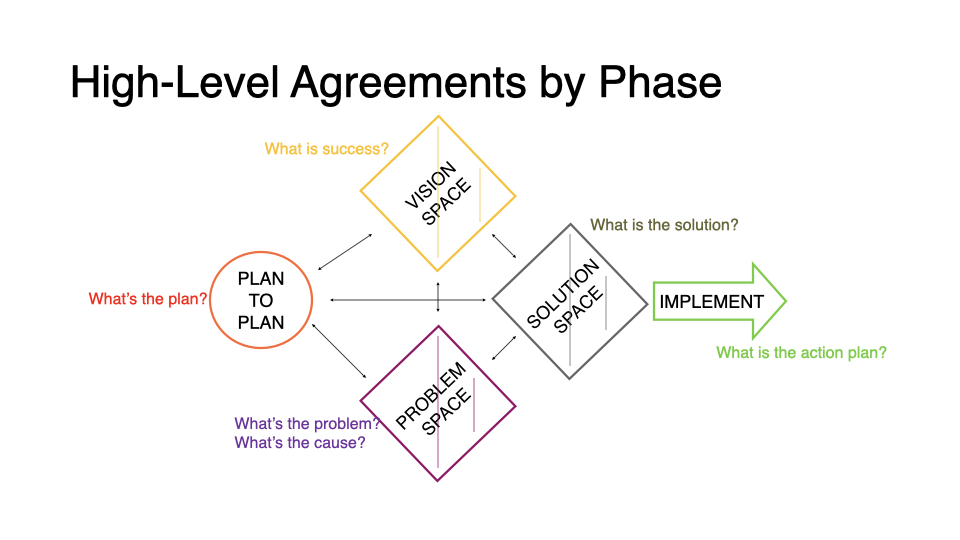
Think of each of the elements (circle, diamonds, arrow) as geographic spaces we are going to travel through — mental “spaces” that each have a specific focus (terrain) we must navigate. Let’s discuss each space.
Plan to Plan
This circle can be thought of as the Leader’s rest area along the journey. We start here to plan the route we think will get us to a perfectly implemented solution. We can come back to this safe area to rest and adjust our plan any time road conditions require a detour or a visit to some local attraction. You cannot lead without a plan, even if the plan gets changed.